
by G. Jack Urso
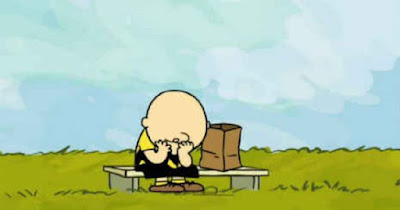
In a world of
Frostys, Grinches, and Rudolphs, A
Charlie Brown Christmas stands out as one of the very few Christmas
specials that include scripture in its dialog directly related to the birth of
Christ. We see this in Linus’ recitation of the annunciation to the shepherds
from Luke, chapter 2. The overall plot, a critique of the commercialization of
the holiday, tapped into mid-century Western angst in the period of post-war
prosperity. Together, these two themes intertwine to elevate the animated
special into an almost spiritual experience.
I was born in
late 1964, so A Charlie Brown Christmas
was one of the first animated Christmas specials I can remember watching, being
planted down in front of the TV at the age of one with my siblings to start
what has been an annual tradition for me ever since. Young viewers could
imagine being part of the Peanuts gang. In fact, the entire concept is from the
child’s point-of-view with nary an adult in sight.
Robbins
performed the role not just in A Charlie
Brown Christmas and It's The Great
Pumpkin, Charlie Brown, but also in the TV specials, You're in Love, Charlie Brown (1967), He's Your Dog, Charlie Brown (1968), It Was a Short Summer, Charlie Brown (1969) and A Boy Named Charlie Brown (1969). In the
1960s, Robbins essentially was Charlie Brown and the unique quality of his
voice virtually defined the role and became the standard by which all later performances
were compared.
Given Robbins’
mental health issues, there is perhaps some irony in a scene early in A Charlie Brown Christmas where Charlie
sits down to discuss his ambivalent feelings about the holiday to Lucy’s 5-cent
psychiatrist. How often, I've thought, did Robbins meet with a court-ordered or
prison psychiatrist and wonder if he could get his five cents back.
Downtown
Charlie Brown
There is a
certain melancholy to A Charlie Brown
Christmas. Charlie Brown is somewhat of an outcast, alternatively rejected
and pitied by the rest of the gang. Even his dog, Snoopy, doesn’t respect
him.
The equally
classic soundtrack by Vince Guaraldi has an overall melancholy feeling to it as
well. Despite the bouncy “Linus and Lucy,” which became the Peanuts
theme, and the ebullient “Christmas
is Coming,” it is largely a reflective work in tone. The other
key original composition for the soundtrack, “Christmastime
is Here,” is wistful, almost somber. Though singing of Christmas
Present, it seems more like a vision of Christmas Past, or a Christmas one
wished for, but never happened.
| A Charlie Brown Christmas soundtrack album by the Vince Guaradi Trio on the Ae13U Sounds YouTube channel. |
At the heart of
the storyline in A Charlie Brown
Christmas is the Christmas tree. Tasked with buying a Christmas tree for
the play, Charlie Brown purchases what is essentially a sickly and rejected overgrown
twig and immediately identifies with it. The tree is not only a stand-in for
Charlie Brown, but also for the Christ Child, who entered the world poor, born
in a manger, and befriended by shepherds and magi who brought his family gifts.
In short order, A Charlie Brown Christmas quickly became
recognized as the apex of children’s animated Christmas specials. Its message
has transcended not only generations, but also religions as people of all
creeds, even atheists, have come to appreciate its timeless message.
One can also not
ignore Robbins’ contribution to its success. Though only nine years old, he
successfully manages to convey the range of emotions from concern, disappointment,
depression, and despair to empathy. It is a remarkable, underrated performance.
Because A Charlie Brown Christmas and
It's The Great Pumpkin, Charlie Brown,
are among the most popular of such TV specials, Robbins’ performances will
likely endure as part of the holidays for as long as they are celebrated.
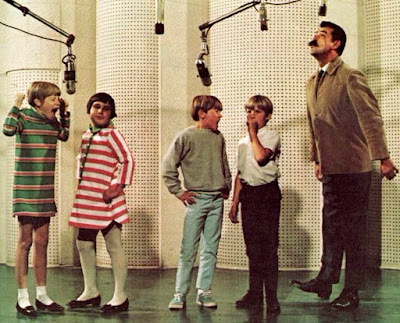 |
| A young Peter Robbins, middle, with director Bill Melendez, far right, and other child voice actors recording for a Charlie Brown special in 1968. |
The
Low-Down on Brown
The Peanuts characters
are archetypes of children one encountered in their own neighborhoods. Everyone
at some point in their life knows someone like or can identify with one of the
gang; however, it is the put-upon Everyman, Charlie Brown, that centers the
strip — the ever hopeful, lonesome loser who always comes in last. The guy who
has the football taken away from him at the last moment when he goes to kick
it, and then gets up to try again and again.
I sometimes
think we enshrine Charlie Brown’s and similar downtrodden characters’ “keep
trying” attitude to alleviate our guilt over the zero-sum calculus of society.
For everyone who succeeds, someone fails. Someone gets a bag filled with candy,
another gets rocks. We need Charlie Browns to keep trying because while we
believe in the inherent inevitability of our success due to persistence, we
fear life is still pretty much a crap shoot.
For anyone, the
burden of that legacy would be heavy. For Robbins, born with a bipolar
disorder, it was overwhelming. Yet, where does one go after peaking at the age
of nine? This is the terrible inheritance for child stars who were part of
iconic film and TV shows, like Anissa Jones (Buffy on Family Affair) discussed in my post “Family Affairs and Pieces of Our Childhood.”
 |
| Robbins at a 2013 court appearance (credit John Gibbins U-T San Diego AP). |
The burden of
Robbins’ bipolar condition led to alcohol, drug, and sex addictions, as well as
obsessive behavior, stalking, threats of violence, and manic episodes. He did
two stints in prison totaling more than five years where he suffered beatings
from other inmates and put in isolation. When I worked in prisons, I once
visited the secure holding units (SHU) at a maximum-security facility. It was a
circle of hell. The thought of Robbins there, battling his own mental illness,
fills me with a deep and profound sense of sorrow and tragedy.
When once
parents struggled with how to tell their children there is no Santa Claus, they
can now add to the list when to tell them Charlie Brown committed suicide.
Somewhere, I
imagine Robbins is with all the other tragic former child actors, becoming
something of a celluloid version of Peter Pan and the Lost Boys — eternally
young, at least on film. Robbins, like the Ghost of Christmas Past, through his
final act, is fated to return every year as a slightly bitter aftertaste to A Charlie Brown Christmas, reminding us
of loss and tragedy every December.
Perhaps it
can also teach us to better appreciate the forgotten Christmas trees in the
world that can still grow and thrive with just a little bit of love.

● ● ●
Once again, Aeolus has resurrected the Underdog - sorry Snoopy - to remind us of his enduring meaning and relevance to humanity. Charlie Brown was indeed a mirror of the 60's. Well done, enjoyed the article. Thank you Peter Robbins, rest in peace.
ReplyDeleteThank you for reading and your kind words!
Delete